By Dr. April Hurley
Do you sometimes feel like you’re looking at the world through a funhouse mirror? It can seem that way if you have myopia or hyperopia, especially when you consider that most children and adults hold their phones, books and tablets about 12 to 16 inches away from their faces. If you’re holding your phone closer, you may be nearsighted or have myopia, and if you’re holding your reading material at arm’s length, you may be farsighted or have hyperopia. Let’s take a look at these eye problems, how they’re diagnosed and how our eye doctors in Atlanta can help you see clearly.
Myopia and hyperopia affect the way light is focused at the back of your eye. Let’s take a look at what they are and how they affect your sight.
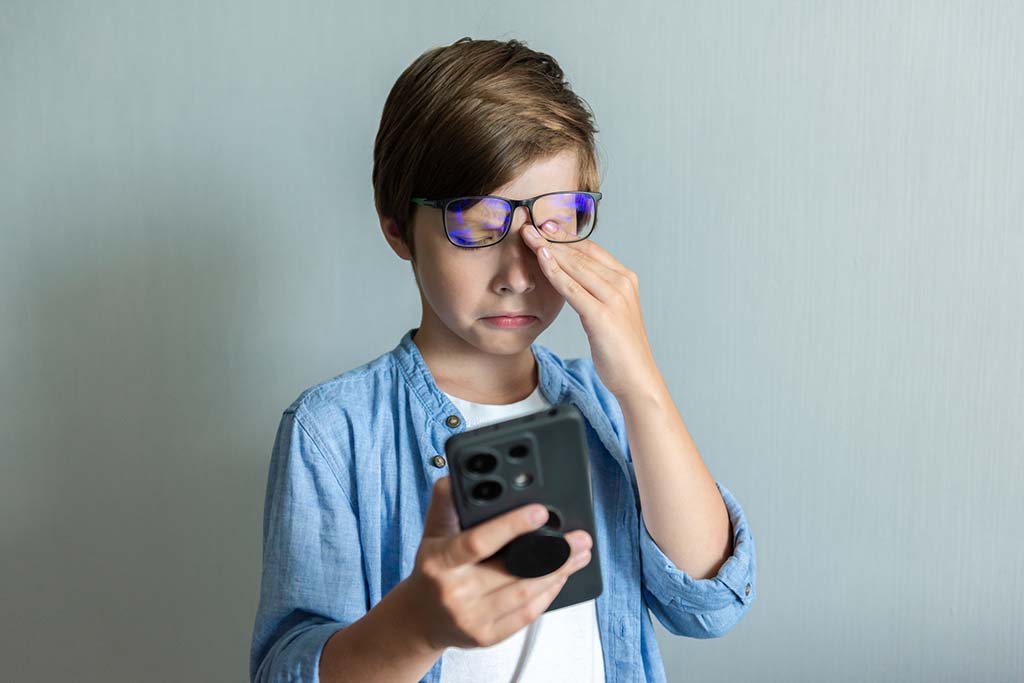
Myopia, also known as nearsightedness, means the individual can see things clearly up close, while things far away appear blurry or wavy, as if they’re underwater or being reflected through a warped mirror. For example, if you’re nearsighted, you can probably read a book and view your phone fine, but you might not be able to read a street sign clearly while you’re sitting in the passenger’s seat of a car or a whiteboard while sitting in a classroom.
For people with hyperopia, seeing the whiteboard or reading street signs in a car is no problem. However, these individuals may have trouble seeing the print in a book or on a smartphone. In other words, they can’t see clearly close-up, but they can see clearly far away.
Vision problems can show up at any age, but the signs often look different depending on whether you’re a baby, child, teen, or adult. Recognizing symptoms like squinting, eye rubbing, blurry vision, headaches or difficulty reading early can help you get an eye exam and correct problems before they affect daily life.
Let’s break down the causes, risk factors and progression expectations of nearsightedness and farsightedness.
Excessive screen time and performing close-up work are not known to directly cause myopia. However, it is believed that staring at objects and words up close can contribute to the progression of the refractive error, especially in children, because their eyes are still developing.
Yes, having hyperopia can be a risk factor for developing lazy eye. It may also lead to eye strain, headaches, difficulty reading and double vision. The good news is that timely treatment, like glasses and contact lenses, can correct vision and help with any complications.
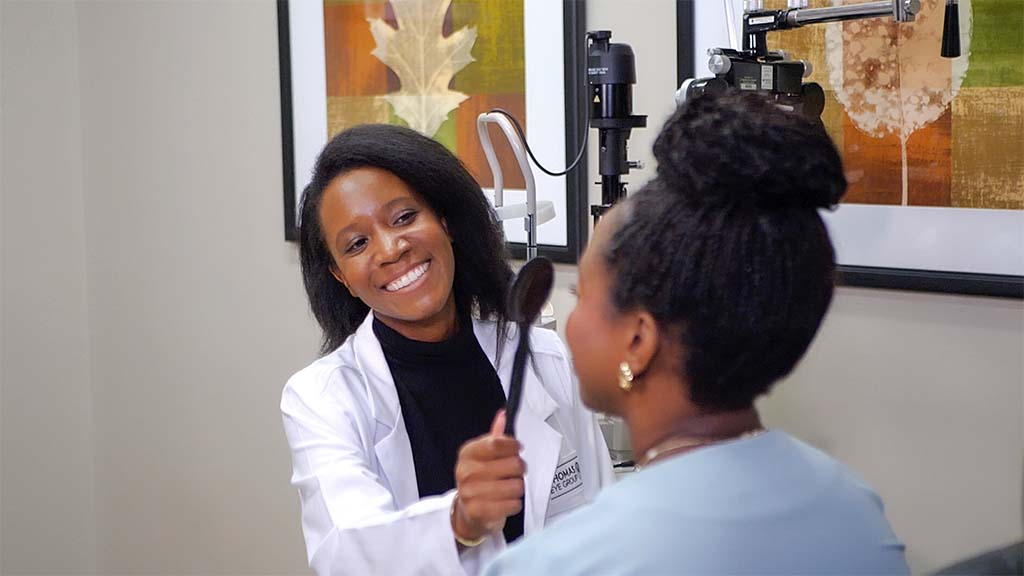
Comprehensive eye exams are used to diagnose myopia and hyperopia. These exams test visual acuity and eye health. If refractive errors are found, corrective lenses are often recommended. If other eye health problems are discovered, a treatment plan will be developed.
During a thorough eye exam, the doctor first checks how clearly you see at different distances. This is called a visual acuity test. Distance vision is checked via a chart projected onto a wall, and near vision is checked via a handheld chart. If vision issues are found, a refraction test is used to determine your eyeglasses or contact lens prescription.
When children’s eyes are being examined, the eye doctor may choose to use special eye drops that relax the focusing muscles. This makes it easier to get an accurate measurement of their refractive error, which determines whether they are nearsighted or farsighted. These drops are safe and only used when needed.
When you get an eyeglasses or contact lens prescription, you might notice a plus (+) or minus (–) sign next to the numbers. A plus sign means that the eye is farsighted, while a minus sign means that the eye is nearsighted.

Vision correction options include glasses, contact lenses and eye surgeries, like LASIK and PRK.
Glasses and contacts act like a second lens for your eye. They redirect light so it lands perfectly on your retina so that you can see clearly. Since your eyes can change over time, it’s important to schedule regular eye exams. They can help ensure that your prescription is up-to-date so that you can see clearly.
There are multiple options for glasses and contact lenses. If you’re not sure which to choose, our eye doctors and optical shop staff can help you find the right type.
There is no cure for myopia or hyperopia at the present time. However, contact lenses, glasses and eye surgery can restore clear vision.
Myopia and hyperopia do cause vision issues. However, individuals with these refractive errors can still go to school, participate in sports, read screens and lead active, full lives.
Myopia and hyperopia are refractive errors, and if they’re left uncorrected, children and adults could have trouble in school, while playing sports and while driving. Nearsighted kids may have trouble reading the board and playing sports. Farsighted kids may have trouble reading books and their phone or doing classwork on a computer or tablet. Eyeglasses and contact lenses can help kids and adults see clearly so that they can perform all of their daily activities.
If you’re nearsighted or farsighted, it’s important to develop habits to protect your vision, like:
If you’re nearsighted or farsighted, it’s important to keep your glasses or contact lens prescription up to date with annual eye exams. However, there are also times when you may need to schedule an appointment sooner.
When you arrive at your scheduled appointment, make sure you bring your glasses or contacts and a copy of your prescription if you have it. Write down any new symptoms you might be having or concerns that you have so that you can ask questions. Our ophthalmologist may ask you about your medical history and/or any medications that you currently take. If your eyes are going to be dilated, you should bring sunglasses and arrange for someone to drive you to and from the appointment.
April Hurley, O.D., F.A.A.O., is a comprehensive optometrist at Thomas Eye Group’s Marietta East-Cobb location, with a special interest in ocular disease management. She earned her Doctor of Optometry degree from Nova Southeastern University and completed a post-graduate ocular disease residency at the University of Pikeville Kentucky College of Optometry. She is a Fellow of the American Academy of Optometry.